
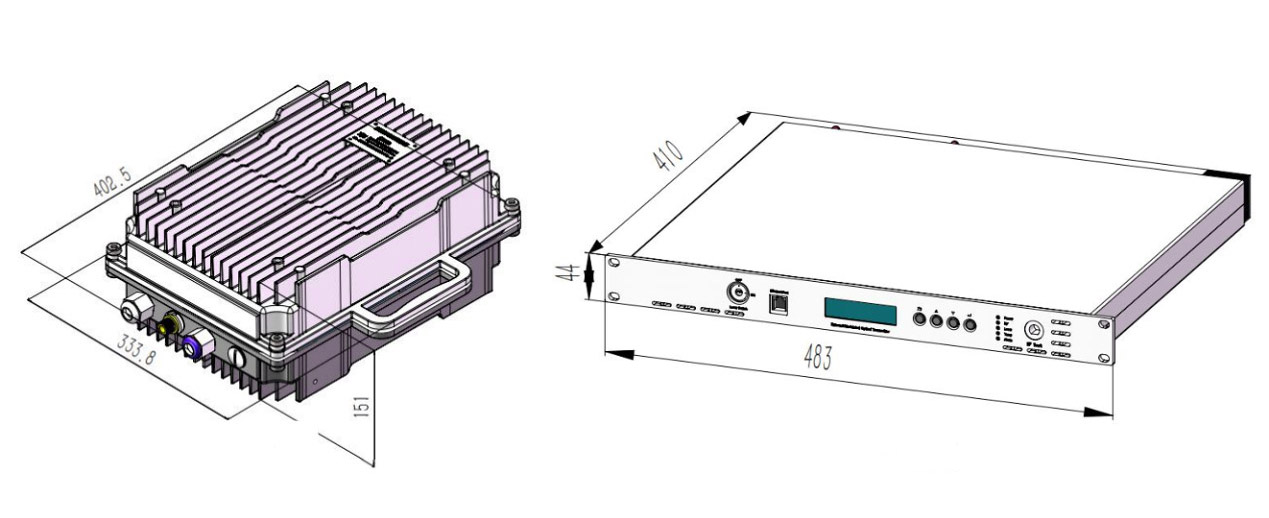
Overview
The RF Remote Transmission System is a series of advanced devices based on composite modulation technology that use optical methods to transmit RF signals. It can directly convert analog RF signals received by radar/antennas into optical signals via electro‑optic modulation without front‑end processing, enabling long‑distance, low‑loss, and distortion‑free transmission.
The system offers clear advantages: long transmission distance, wide dynamic range, strong immunity to EMI, high confidentiality, and flexible deployment. It resolves site selection constraints caused by coaxial cables being prone to EMI, limited transmission distance, and high signal loss. At the same time, it overcomes the limitations of digital fiber optic transmission, which requires front‑end signal frequency conversion and encryption, making unattended operation difficult and limiting dynamic range due to analog‑to‑digital conversion. As such, the system is a modern key approach for high‑quality, long‑distance signal transmission between radar sites, antenna fields, and control center.
Applications
- Remote placement of HF, VHF/UHF, and microwave antennas
- Distributed radar deployment and radar data transmission across various frequency bands
- Satellite communications
- Mobile unit communications
- Unmanned antenna fields
Product Features
- Wideband coverage: Covers the full frequency range from 1.5MHz to 30GHz.
- Long‑haul transmission: Up to 50km without repeaters; unlimited distance with repeaters.
- Remote command and control: Centralized network management allows local real‑time monitoring, control, and management of remote equipment.
- Adjustable gain: Local equipment adjusts the signal gain of remote equipment.
- Fully transparent operation ensures complete and accurate raw data transmission, compatible with various signal encoding, communication standards, and network protocols.
- All‑optical transmission link networking supports mixed local and remote antenna placement, as well as flexible centralized and distributed deployment of multiple radio stations.
Please log in to view the full article.
